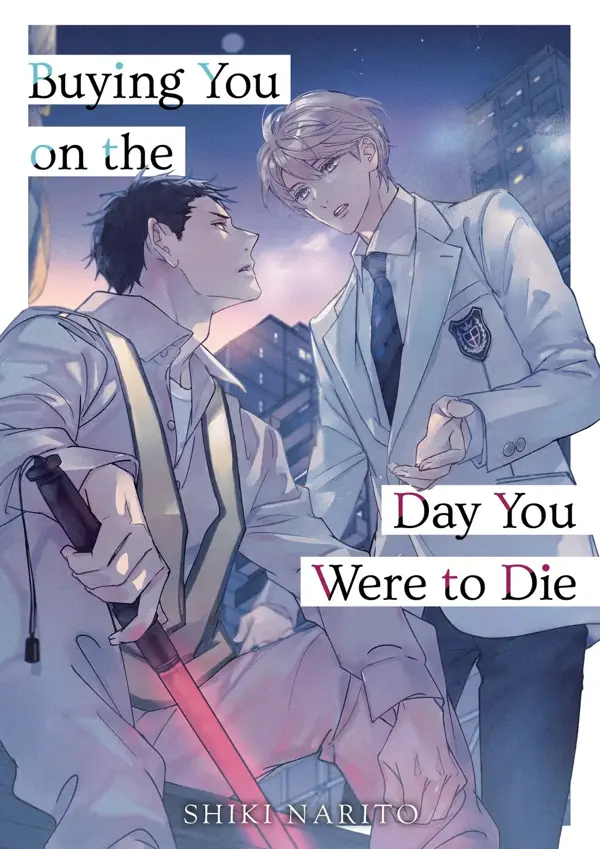
Official Synopsis:
“I’d like to buy your time—for two hundred thousand yen a month.” For Sakata, the winter of his junior year brings nothing but loss. His mother is dead, his useless father is gone, and each day nearly costs him everything he has left. Then a young man named Nishikawa approaches him with an offer—and generous pay that could give his mother a proper funeral. However, the deal comes with several bizarre conditions that Sakata must meet: go to school every day, get into the same university as Nishikawa, and lastly, act like his friend until the end of their contract. As their bond deepens, the two boys starved for love must face the question neither dared to ask: Can a friendship built entirely on money turn into something real?
Just by the title and synopsis, I knew this book was going to be a tearjerker, and it certainly was. It’s a pretty short book too, so I was able to read it in one afternoon. Due to its length, the story only really develops the two main characters, Sakata and Nishikawa, with little time given to anyone else.
There is some brief development of Sakata’s best friend, Toyota, but it’s mainly to juxtapose Sakata’s new circumstances (and feelings of survivor’s guilt) against his friend. Toyota is in a similarly dire position as Sakata, facing an abusive family without anybody to protect him. Meanwhile, Sakata was saved (monetarily and mentally) by Nishikawa’s offer of hiring Sakata as a friend/companion. Nishikawa offers not only financial freedom, but the solace and comforts of a real family.
The story is a deeply emotional examination of what it means to love someone (friends, family, significant other, etc.) without being about romance. There’s no fairy-tale happy ending here, but there was significant character growth and emotional catharsis. There were several moments that brought me to tears, specifically:
I wouldn’t call this a light read at all, and was actually curious whether it was actually a “real” light novel, since this book is very different from J-Novel’s usual fare. When I researched it after the fact, I learned that the original publisher, Kadokawa Media Works Bunko, has actually shelved this in the “literary” category rather than “light novels” which makes a lot of sense given both the content and writing style.
I would recommend this book, though it might be prudent to be ready with some tissues!
Comments
Comments are fetched from the Fediverse. You can join the conversation by replying to this post on Hollo. New replies will appear here after the next site rebuild. If you don't have a fedi account, you can send me your comment below.